How do I find a local drone pilot for a solar park inspection in Romania? A complete guide
Published on Updated on 9 min read
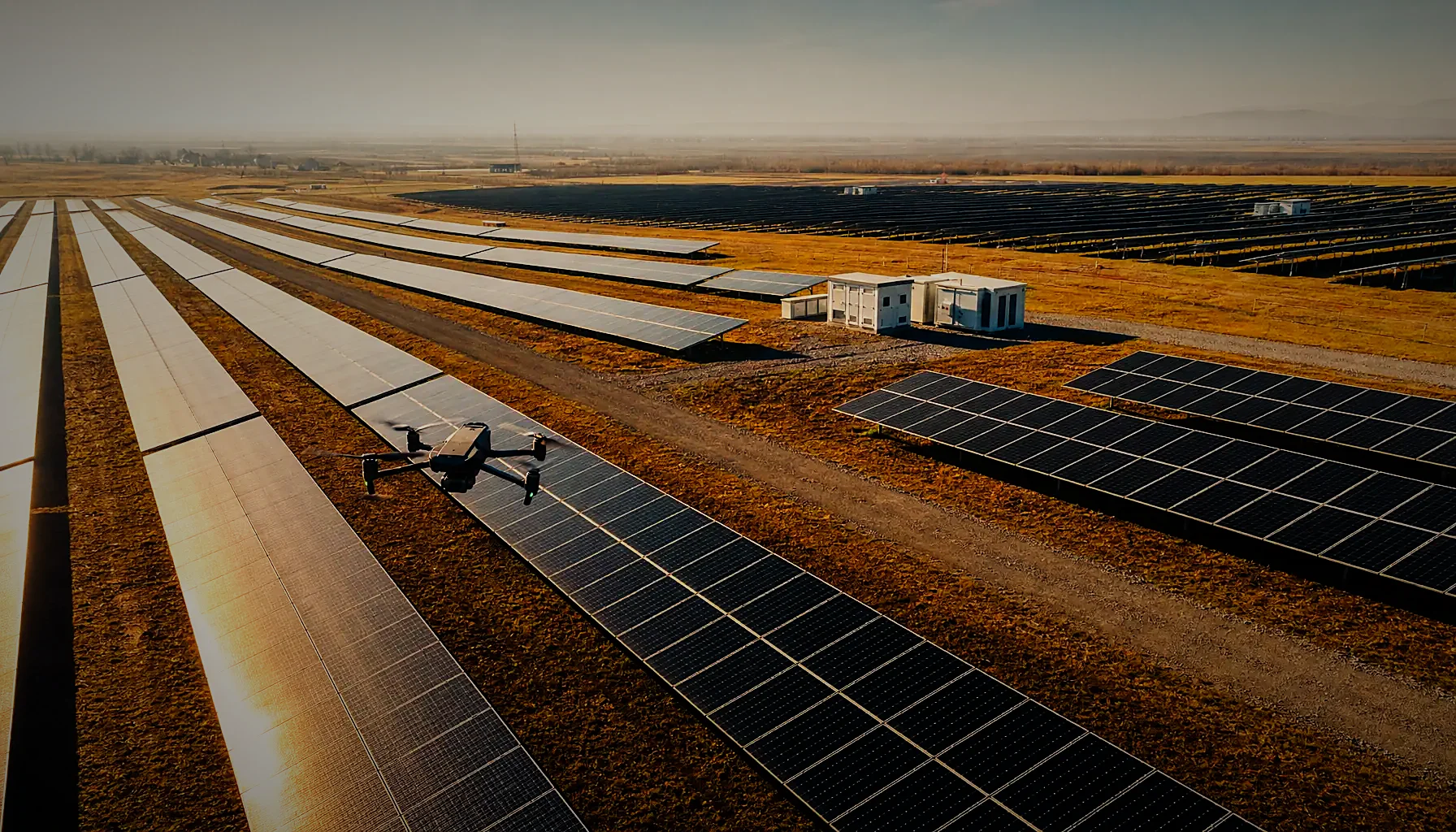
To find a local drone pilot for a solar park inspection in Romania, shortlist operators who hold EASA open category A1/A3 and A2 certificates, own a radiometric thermal camera, and can state their GSD, overlap and irradiance thresholds in writing. Ask for a sample dataset and a report. Then confirm mobilisation time to your site.
What does a qualified drone pilot for a solar park inspection actually need?
A pilot qualified for PV thermography needs three things: EASA open category certification, a radiometric thermal sensor, and a documented acquisition specification. Without all three, the dataset will not pass review on a PV analytics platform.
Certification comes first. In Romania, commercial drone work falls under the EASA regulation, so pilots operate under the open category with A1/A3 and, for flights closer to people and structures, A2 competence.
The sensor matters just as much. A radiometric thermal camera records a temperature value per pixel, which is what anomaly classification depends on. A non-radiometric camera produces a coloured picture with no measurable data behind it.
Drone Data, based in Bucharest / Ilfov, flies with the DJI Mavic 3T, which carries a radiometric 640×512 thermal camera and a 48 MP RGB camera. Heavier platforms such as the DJI Matrice 350 RTK and the Mavic 3 Enterprise are used on larger missions.
The third item is the written specification. An operator who cannot tell you the ground sampling distance, the front and side overlap, and the minimum irradiance they fly in is guessing. Ask for those numbers before anything else.
Following the recommendations of IEC TS 62446-3, thermography of PV modules is flown at a minimum irradiance of 600 W/m². Below that threshold, cell defects do not produce a thermal signature strong enough to classify reliably.
How do I find a local drone pilot for a solar park inspection in Romania, step by step?
Work through five steps: define the deliverable, check certification, request the acquisition specification, review a sample dataset, then confirm mobilisation and report turnaround. The whole process takes a few days, not weeks, because a quote on a defined scope comes back within 24 hours on working days.
Step 1 — define the deliverable. Decide whether you need a PDF anomaly report, a raw EXIF-intact dataset for your own platform, an orthomosaic, or all three. The deliverable drives the flight plan, not the other way round.
Step 2 — check certification. Ask for the EASA A1/A3 and A2 certificates of the pilot who will actually be on site, not of the company in general.
Step 3 — request the specification. A serious operator replies with numbers: for example 6 cm GSD, 85% front overlap and 65% side overlap, flown above 600 W/m² irradiance. Those values are checkable, which is the point.
Step 4 — review a sample. Look at one real dataset and one real report. Check that EXIF and GPS tags are intact, that thermal and RGB frames are paired, and that the folder structure matches what your platform’s uploader expects.
Step 5 — confirm timing. Mobilisation anywhere in Romania takes 24 to 72 hours. For parks up to 20 MW, report turnaround is 5 working days from the flight.
If you are scoping a single mid-size asset, our breakdown of how long a thermal inspection of a 10 MW solar park takes gives the hour-by-hour picture of a typical site day.
See the specification before you book
Our solar farm thermal inspection page lists the acquisition conditions we fly in, the deliverables you get and the report turnaround — the same numbers you should ask any pilot for. Check them against your own shortlist.
Local pilot, national operator or international subcontractor — which option fits?
For a single site under 5 MW, a nearby pilot with the right sensor is often enough. For a portfolio spread across counties, a national operator removes coordination work. For cross-border programmes, an international provider with a local acquisition partner in Romania is the usual arrangement.
The trade-offs are mostly about consistency and travel time. A local pilot is close to the site but may use a different specification on each job. A national operator keeps one specification across the portfolio.
| Criterion | Nearby individual pilot | National operator in Romania | International provider |
|---|---|---|---|
| Travel to site | Short, often same day | Mobilisation in 24 to 72 hours anywhere in Romania | Days, plus customs and logistics for equipment |
| Radiometric thermal camera | Sometimes | Standard | Standard |
| Consistency across sites | Varies by pilot | One specification, one technical contact | One specification, local subcontractor executes |
| Dataset to platform format | Rarely offered | Delivered in the platform’s folder structure or uploader | Usually yes |
| Local airspace knowledge | Good locally | National coverage | Dependent on the subcontractor |
| Best fit | One small rooftop or park | Portfolios, repeat annual inspections | Multi-country programmes |
Subcontracting drone inspection work in Romania to a local operator is the standard model for PV analytics platforms and pilot networks. The platform owns the analysis; the local operator owns the flight and the dataset quality.
That split works when the acquisition specification is fixed in advance. Drone Data flies to the platform’s own specification and delivers complete datasets with EXIF and GPS intact, through the platform’s uploader or in its folder structure.
One more practical point: a single operator can cover the whole country. In 2026 Drone Data has flown over 400 MW of PV capacity across Romania, with the largest single mission at about 60 MWp over about 70 ha, completed in one or two flight days.
What should I ask a drone operator before booking an inspection?
Ask ten questions and judge the answers by how specific they are. Certification, sensor type, GSD, overlap, irradiance threshold, flight capacity per day, deliverable format, report turnaround, mobilisation time, and who your technical contact is from brief to delivery.
Certification and crew. Which pilot flies the mission, and which EASA certificates do they hold? A1/A3 and A2 cover the open category operations relevant to most solar parks.
Sensor and resolution. Is the thermal camera radiometric, and what resolution is it? A 640×512 radiometric sensor is the working baseline for utility-scale PV.
Acquisition specification. What GSD do you fly, and what front and side overlap? If the answer is “whatever looks good”, the dataset will not survive automated stitching or anomaly detection.
Weather and irradiance rules. At what irradiance do you start and stop flying? The answer should reference 600 W/m² as the minimum and include wind and cloud cover limits, because moving cloud shadow ruins thermal consistency.
Capacity and schedule. How much can you fly in one day? On a day of good irradiance, Drone Data flies up to about 50 MW; a roughly 10 MW park takes about 2 h 15 min of on-site flight time.
Deliverables. What exactly arrives, and in what format? Expect a PDF report, orthomosaics, 3D models where relevant, and the complete dataset with EXIF intact.
Turnaround and contact. For parks up to 20 MW, reports are delivered in 5 working days. Confirm that one technical contact stays with the project from brief to delivery, so nothing gets re-explained mid-mission.
Do I need flight permissions for a solar park inspection in Romania?
Yes — airspace clearance is required, and the operator should handle it as part of the mission. In Romania, drone flights need authorisation from the civil aviation authority and, depending on the location, coordination with the airspace manager. A competent operator files this before mobilisation, not on the morning of the flight.
The practical checks are geography-driven. Proximity to an airport, to military zones, or to restricted areas changes the lead time and sometimes the flight altitude available.
You also need site-side permission. The asset owner or O&M contractor grants access, confirms safety induction requirements, and tells the crew which inverter stations and strings are live.
Permissions are one reason mobilisation is quoted as 24 to 72 hours rather than same day. That window covers authorisation, weather confirmation against the 600 W/m² irradiance threshold, and travel.
Ask the operator to send the authorisation reference and the planned flight window in writing. If the weather turns and irradiance stays below threshold, the flight moves rather than producing an unusable dataset.
For rooftop PV in urban areas, A2 competence matters more, because flights happen closer to buildings and uninvolved people. This is where the certificate stops being paperwork and starts defining what the pilot is allowed to do.
What do I receive after a drone thermal inspection, and how is it delivered?
You receive four things: a PDF anomaly report with located and classified findings, the radiometric thermal dataset, the paired RGB imagery, and an orthomosaic where the scope includes mapping. Every file keeps its EXIF and GPS tags.
The report lists anomalies by type and location — hot cells, hot spots, bypassed substrings, open-circuit strings, soiling and shading effects — with the module position so field crews can find them.
Analysis and reporting are done in-house. Photogrammetry outputs use RealityCapture, point clouds are handled in CloudCompare, and PPK corrections through ROMPOS bring positional accuracy down to centimetre level.
Delivery follows your system, not ours. Datasets go through the platform’s own uploader or arrive in the folder structure the platform specifies, so no one spends a day renaming files.
Coverage is verified on site before the crew leaves. Checking frame count, overlap and thermal consistency in the field is cheaper than discovering a gap after the dataset reaches the analytics queue.
On cadence: most asset owners run a full thermal inspection annually, with a second pass after commissioning, after major weather events, or when string-level monitoring flags an unexplained production drop. An annual baseline makes year-on-year degradation comparable.
Request a personalised quote with your site coordinates, installed capacity in MW and preferred acquisition specification, and you will have a scope and schedule back within 24 hours on working days.
Thermal inspection for your park in Romania
We fly above 600 W/m² with a radiometric camera and send reports within 5 working days for parks up to 20 MW. Have a look at how a site day and the deliverables work.
Frequently asked questions
What certification does a drone pilot need for commercial work in Romania?
Commercial drone work in Romania follows the EASA regulation, so pilots need open category competence — A1/A3 as the baseline and A2 for operations closer to people and structures. The operating company must also be registered and hold airspace authorisation for each mission. Drone Data’s pilots hold EASA A1/A3 and A2 certificates and fly missions across the whole country.
How fast can a pilot mobilise to a site in Romania?
Mobilisation anywhere in Romania takes 24 to 72 hours from a confirmed brief. That window covers airspace authorisation, site access coordination and a weather check against the 600 W/m² irradiance threshold required for thermography. Quotes on a defined scope come back within 24 hours on working days.
What should you ask a drone operator before booking an inspection?
Ask for the pilot’s EASA certificates, the thermal camera type and resolution, the GSD and overlap they fly, the minimum irradiance they accept, the deliverable format and the report turnaround. Specific numbers signal a repeatable process; vague answers signal improvisation. For example, a typical PV specification is 6 cm GSD with 85% front and 65% side overlap, flown above 600 W/m².
Do you need flight permissions for a solar park in Romania?
Yes, drone flights over a solar park in Romania require civil aviation authorisation and, near airports or restricted zones, airspace coordination. The operator should file these before mobilisation and send you the authorisation reference in writing. You also need site access permission from the asset owner or O&M contractor.
Can one operator cover sites across the whole country?
Yes. A single operator can cover a national portfolio, which keeps one acquisition specification and one technical contact across every site. Drone Data flew over 400 MW of PV capacity in Romania during 2026, including a mission of about 60 MWp over about 70 ha completed in one or two flight days.
How long does a thermal inspection of a solar park take?
On-site flight time for a roughly 10 MW park is about 2 h 15 min, and on a day of good irradiance up to about 50 MW can be flown. Report turnaround for parks up to 20 MW is 5 working days from the flight date. Larger sites are split across one or two flight days depending on irradiance hours.
Related services
Thermal and visual drone inspections
Roofs, facades, industrial halls, power lines and wind turbines inspected from the air, with an annotated report and a ranked defect list.
See the service
Solar farm thermal inspection
Radiometric thermal and RGB survey of PV plants, with every anomaly classified and located by string and module. Report in 5 working days for plants up to 20 MW.
See the service
Tell us about your site
Send the location, the size and the deliverable you need. We reply with a written quote and a proposed flight window.
- Reply within 24 h on working days
- Written quote, no obligation
- Your data stays confidential
We work across Romania, with mobilization in 24–72 h.