How often should a solar park be inspected with a thermal drone? A complete guide
Published on Updated on 10 min read
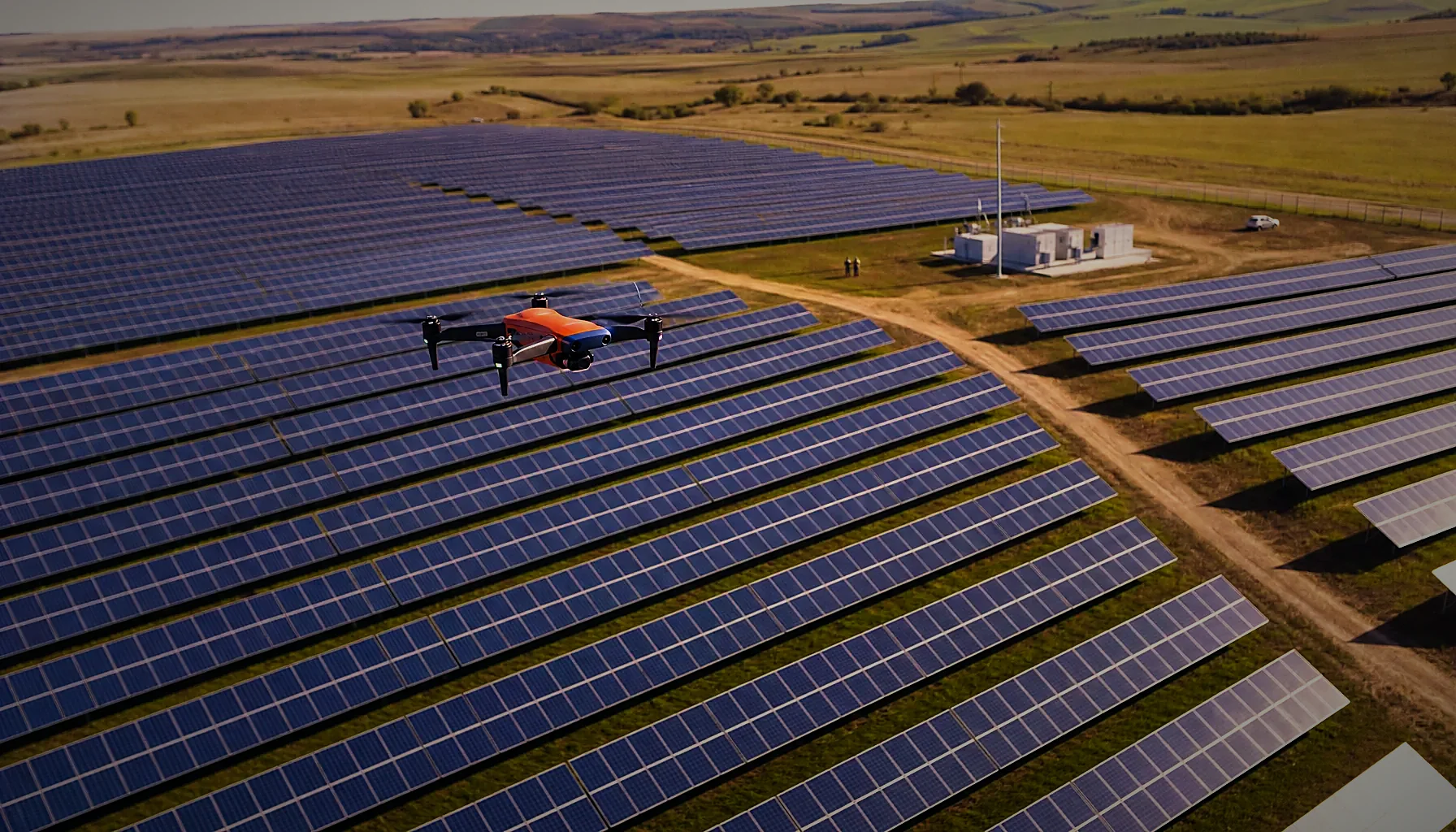
A hot cell that nobody sees keeps producing heat all year. A solar park should be inspected with a thermal drone once a year as a baseline, twice a year for parks above roughly 10 MW or with a history of defects, and again after any hail, storm or major electrical work. This schedule follows the recommendations of IEC TS 62446-3.
How often should a solar park be inspected with a thermal drone?
Once a year is the minimum for every grid-connected park. Twice a year — typically late spring and late summer — suits parks above about 10 MW, parks with known string or diode faults, and assets under warranty claims. Add an event-driven flight after hail, strong wind or inverter replacement.
The reason for the annual floor is simple: thermal anomalies are cumulative. A bypass diode that failed in March will still be failing in October, and a hot junction box can degrade the cable it sits next to for the whole intervening period.
The reason for the second flight is seasonal. Modules behave differently at 15 °C ambient and at 35 °C ambient, and some resistive faults only show a clear thermal signature once cell temperature rises. A late-summer flight tends to surface connection problems that a spring flight missed.
For a practical frequency table that matches most Romanian portfolios in 2026:
- Parks up to 5 MW: one flight per year, plus event-driven flights.
- Parks 5–20 MW: one to two flights per year depending on O&M contract and fault history.
- Parks above 20 MW: two flights per year, often split across sub-arrays.
- Rooftop PV on commercial halls: one flight per year, timed with the roof inspection.
- Parks in first-year commissioning: one acceptance flight plus one at the end of the first production season.
Portfolio owners frequently combine the two. The annual flight produces the full baseline dataset for the analytics platform; the second flight is a shorter follow-up over the sub-arrays that showed anomalies.
What does the IEC TS 62446-3 standard say about inspection frequency and conditions?
IEC TS 62446-3 is the technical specification that governs outdoor infrared thermography of photovoltaic modules and systems. It does not fix a calendar frequency; it defines the conditions under which a thermal measurement is valid. The key threshold is irradiance of at least 600 W/m² in the plane of the array.
Below 600 W/m² the temperature difference between a healthy cell and a faulty one becomes too small to classify reliably. A dataset flown at 400 W/m² may look acceptable on screen and still fail review inside a PV analytics platform.
The standard also expects stable conditions: low wind, little cloud movement, and modules that have been under steady irradiance long enough to reach thermal equilibrium. Scattered cloud is the most common reason a flight window is cut short in Romania.
Practical consequences for scheduling in 2026:
- Flight windows in Romania are realistically 10:00–16:00 for most of the production season.
- April to September gives the widest choice of compliant days; March and October are workable but tighter.
- A cold, clear winter day often fails the irradiance test even though visibility looks ideal.
- Wind above moderate levels cools module surfaces unevenly and flattens anomaly signatures.
This is why an inspection date is best booked as a window rather than a fixed day. Mobilization anywhere in Romania takes 24 to 72 hours, which makes it realistic to lock a date once the forecast is clear instead of committing three weeks ahead and flying in unsuitable light.
Compliance with the recommendations of IEC TS 62446-3 is also what makes a report usable in a warranty or insurance conversation. A manufacturer reviewing a module claim will ask about irradiance, ambient temperature and camera specification before looking at the thermal image.
Plan your next thermal inspection flight
See the acquisition conditions we fly under, what the report contains and how long it takes. Everything is on our solar farm thermal inspection page.
When should you order an extra inspection outside the annual schedule?
Order an extra thermal flight after any event that can damage cells or connections: hail, strong wind, flooding, lightning, inverter or combiner box replacement, module swaps, or an unexplained drop in specific yield. Post-hail PV inspection is the single most common reason for an unscheduled flight.
Hail damage is the clearest case. Cracked cells frequently leave the glass visually intact, so a walk-through finds nothing while the thermal image shows a clear pattern of hot cells and hot sub-strings across the affected rows.
A post-hail flight is most useful within days of the event, for two reasons. The damage pattern is still clean and uncontaminated by later degradation, and insurers and manufacturers tend to treat prompt documentation more seriously than a report produced three months later.
Other triggers worth a flight outside the annual plan:
- Yield deviation: a sub-array underperforming its neighbours by a margin the monitoring system cannot explain.
- Post-construction acceptance: before the EPC handover, to document the plant’s starting condition.
- Before a transaction: technical due diligence for a sale or refinancing.
- End of warranty: a flight 3–6 months before a module or workmanship warranty expires.
- After vegetation or animal damage: rodent damage to DC cabling shows as hot spots at connection points.
The due-diligence case is often the highest value per flight. A buyer evaluating a 20 MW asset learns more from one compliant thermal dataset with anomaly classification than from a year of inverter-level monitoring data, because the thermal dataset localises the problem to the module and string.
How long does a thermal inspection take, and how does that affect your maintenance plan?
Flight time is rarely the constraint. A roughly 10 MW solar park is flown on site in about 2 h 15 min, and on a day of good irradiance the practical capacity is up to about 50 MW. Reporting, not flying, sets the pace of a maintenance plan.
For a sense of scale: the largest mission flown in 2026 covered about 60 MWp over about 70 ha and was completed in one or two flight days. Total PV capacity flown in 2026 passed 400 MW.
Report turnaround for parks up to 20 MW is 5 working days from the flight. That includes radiometric processing, anomaly detection and classification, and the PDF report with module-level localisation.
So a realistic timeline from first contact to a report in your hands looks like this:
- Quote: 24 hours on working days, once array layout, capacity and the required deliverables are known.
- Mobilization: 24 to 72 hours anywhere in Romania, scheduled against the irradiance forecast.
- Flight day: about 2 h 15 min of flying for a roughly 10 MW park; coverage checked on site before leaving.
- Analysis and report: 5 working days for parks up to 20 MW.
If you want the detailed breakdown of a single mission — flight lines, battery swaps, coverage checks — we have written up the full timeline of a 10 MW thermal inspection, including what happens between landing and the first processed dataset.
For planning purposes, build 2–3 weeks of slack into the maintenance calendar between the decision to inspect and the start of repair work. That covers the quote, the weather window, the flight and the report, without forcing a flight into unsuitable conditions.
What do you actually receive after a drone thermal inspection?
You receive a PDF report with every anomaly classified and localised to module level, the complete radiometric and RGB dataset with EXIF and GPS intact, and — where requested — the dataset uploaded directly through your PV analytics platform’s own uploader or delivered in its folder structure.
The report is the working document for the O&M team. Each anomaly carries a type (hot cell, hot sub-string, bypass diode, junction box, soiling, shading, full module failure), a severity, and a position reference that matches the array layout so a technician can walk straight to the right table.
The dataset matters as much as the report. Radiometric images with intact EXIF and GPS can be re-analysed later, compared year on year, and ingested by a platform without manual geotagging. Stripped metadata turns a usable archive into a folder of pictures.
Acquisition parameters are set to the specification the receiving platform asks for. A typical requirement is 6 cm GSD with 85% front and 65% side overlap; those numbers drive flight altitude, speed and line spacing, and they are fixed before the drone leaves the ground rather than discovered afterwards.
The hardware behind it is a DJI Mavic 3T with a radiometric 640×512 thermal camera and a 48 MP RGB camera, with heavier platforms — DJI Matrice 350 RTK and Mavic 3 Enterprise — for larger missions. Pilots hold EASA open category A1/A3 and A2 certificates.
Anomaly detection and reporting are done in-house. Where the same mission also needs mapping outputs — orthomosaic, 3D model, point cloud, volume calculation — RealityCapture and CloudCompare handle the photogrammetry, with PPK corrections through ROMPOS for centimetre-level accuracy.
How do you build an annual PV inspection schedule for a Romanian portfolio?
Start from the production season, not the financial year. Place the main thermal flight between April and September when irradiance reliably exceeds 600 W/m², reserve a second window for parks above 10 MW, and keep an event-driven slot free for hail season. Then work the repair window in behind the report.
A workable annual plan for a mixed portfolio:
- March: confirm array layouts, platform specifications and deliverable formats; request quotes.
- April–June: main thermal flights across the portfolio, largest assets first.
- June–August: repairs scheduled from the reports; keep capacity free for post-hail inspections.
- August–September: follow-up flights on parks above 10 MW and on sub-arrays that were repaired.
- October: year-on-year comparison against the previous dataset; input for the next budget cycle.
Sequencing matters for larger portfolios. Because up to about 50 MW can be flown in a day of good irradiance, several parks within reasonable driving distance can share one mobilization, which compresses the whole campaign into fewer weather windows.
Keep the specification identical year on year. Same GSD, same overlap, same altitude, same palette — otherwise the comparison between the 2026 dataset and the next one tells you more about the flight plan than about the modules.
One technical contact from brief to delivery is worth asking for. Array layout questions, platform upload credentials and anomaly queries all land with the same person, which removes most of the back-and-forth that slows a portfolio campaign.
For assets outside Romania held in the same portfolio, neighbouring countries are possible on request for partner missions. Contact us for details on scope and scheduling.
One flight a year, or two?
Tell us the size of your park and its fault history, and we will set a flight window that meets the 600 W/m² threshold. Reports for parks up to 20 MW land in 5 working days.
Frequently asked questions
Is thermal imaging inspection worth it?
Yes — thermal imaging is the only practical way to find module-level faults across a whole park without disconnecting strings or walking every row. A single flight localises hot cells, failed bypass diodes and hot junction boxes to the individual module, so repair crews go straight to the fault. For a roughly 10 MW park, that is about 2 h 15 min of flying instead of weeks of manual testing.
How often should solar PV be inspected?
Inspect solar PV with a thermal drone once a year as a minimum, and twice a year for parks above roughly 10 MW or with a known fault history. Add an unscheduled inspection after hail, storms, lightning or major electrical work. Rooftop PV on commercial buildings is usually flown once a year, timed to coincide with the roof inspection.
What irradiance is required for a thermal inspection of PV modules?
A minimum of 600 W/m² in the plane of the array, following IEC TS 62446-3. Below that threshold the temperature difference between healthy and faulty cells is too small to classify reliably, and the dataset may be rejected by a PV analytics platform. In Romania this usually means flying between 10:00 and 16:00 from April to September.
What is the 20% rule for solar panels?
The 20% rule is a rough screening threshold: a module or string producing around 20% less than its neighbours under the same conditions is treated as a fault worth investigating rather than normal spread. It is a monitoring heuristic, not a standard, and it only flags that something is wrong — not what or where. A thermal drone inspection is what converts that signal into a specific module and defect type.
How long does a thermal inspection of a 10 MW solar park take?
About 2 h 15 min of flying on site for a roughly 10 MW park, with coverage verified before the crew leaves. Report turnaround for parks up to 20 MW is 5 working days from the flight date. Mobilization anywhere in Romania takes 24 to 72 hours, and quotes are returned within 24 hours on working days.
How do I find a drone pilot for a solar park inspection in Romania?
Ask for three things before anything else: EASA open category certification, a radiometric thermal camera, and willingness to fly to your analytics platform’s exact specification. Drone Data operates from Bucharest and Ilfov with missions anywhere in Romania, EASA A1/A3 and A2 certified pilots, and a DJI Mavic 3T with a radiometric 640×512 thermal camera. Send the array layout and required deliverables and you get a quote within 24 hours on working days.
Related services
Thermal and visual drone inspections
Roofs, facades, industrial halls, power lines and wind turbines inspected from the air, with an annotated report and a ranked defect list.
See the service
Solar farm thermal inspection
Radiometric thermal and RGB survey of PV plants, with every anomaly classified and located by string and module. Report in 5 working days for plants up to 20 MW.
See the service
Tell us about your site
Send the location, the size and the deliverable you need. We reply with a written quote and a proposed flight window.
- Reply within 24 h on working days
- Written quote, no obligation
- Your data stays confidential
We work across Romania, with mobilization in 24–72 h.