What irradiance is required for a thermal inspection of PV modules? A complete guide
Published on Updated on 10 min read
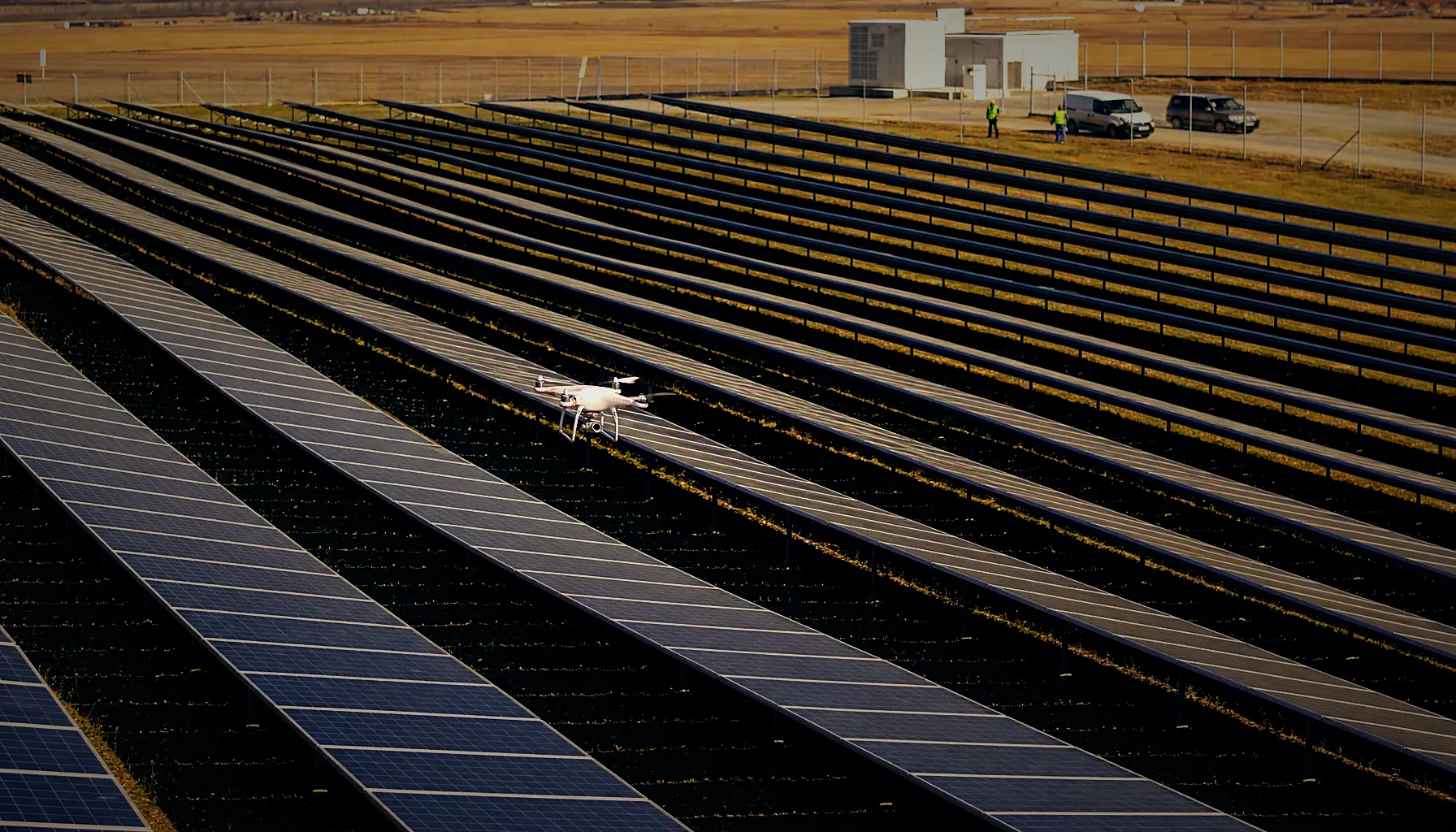
The irradiance required for a thermal inspection of PV modules is at least 600 W/m², the minimum value recommended by IEC TS 62446-3. Below that threshold, the temperature difference between a healthy cell and a faulty one becomes too small to read reliably in a radiometric thermal image. Most inspections in Romania are flown between 10:00 and 16:00 in clear conditions.
What irradiance is required for a thermal inspection of PV modules, and why 600 W/m²?
600 W/m² is the floor. IEC TS 62446-3 sets it because a cell defect only shows up in a thermal image when enough current is flowing through the string to heat the fault. Less sun means less current, and less current means a weaker thermal signature.
A hot spot is not hot by itself. It becomes hot because a shaded, cracked or mismatched cell is forced into reverse bias and dissipates the power the rest of the string is producing. At 300 W/m², that dissipated power roughly halves, and the delta drops with it.
In practice, a bypass diode failure or a hot cell that reads 20 K above the module average at 900 W/m² may read only 6 to 8 K at 350 W/m². Noise in a 640×512 radiometric sensor, reflected sky temperature and wind cooling then start to compete with the signal. The anomaly is still there; your ability to classify it is not.
This is why we treat 600 W/m² as a go or no-go condition before take-off, not as a nice-to-have. A dataset flown under the threshold is cheap to produce and expensive to trust, because every borderline anomaly has to be re-flown anyway.
Which conditions matter besides irradiance for drone thermography of solar panels?
Irradiance is the first condition, not the only one. Wind speed, ambient temperature, cloud stability and sun angle all change how clearly a fault appears, and a dataset can fail the quality check even at 900 W/m² if wind is cooling the back sheet or broken cloud is modulating the light.
Wind is the most underrated factor. Above roughly 5 to 6 m/s, convective cooling flattens temperature differences across the module surface, and marginal anomalies such as a single warm cell start to disappear into the background.
Broken cloud is worse than full overcast. Overcast simply means no flight; scattered cloud means irradiance swings from 850 to 300 W/m² and back within one flight line, so adjacent images are no longer comparable and the analyst cannot apply one consistent temperature scale.
Sun angle matters for reflections. Early morning and late afternoon low-angle sun produces specular glare on the glass that a thermal sensor reads as apparent temperature, which is why inspections sit in the middle of the day.
Condition thresholds we check before take-off
- Irradiance: 600 W/m² minimum, measured on the plane of the modules.
- Wind: stable and low; strong wind suppresses the thermal delta.
- Cloud: clear or stable thin high cloud. No broken cloud passing over the array.
- Time window: typically 10:00 to 16:00, with the sun high enough to avoid glare.
- Plant state: inverters running and the plant exporting, so current is flowing through every string.
The last point is the one most often missed. A curtailed or tripped inverter produces modules that are electrically idle, and an idle string hides nearly every current-related defect regardless of how bright the day is.
See how we fly a solar park inspection
Our solar farm thermal inspection page lists the exact acquisition conditions we check before take-off, the deliverables you receive and how long the report takes. Worth a look if you are planning an inspection this season.
How is irradiance measured on site, and how accurate does it need to be?
Irradiance is measured on site with a calibrated pyranometer or a reference cell held in the plane of the modules, and cross-checked against the plant’s own monitoring sensors. A plane-of-array reading is required because a horizontal reading can understate the real value at the module surface by 10 to 20% on a tilted array.
A handheld reference cell is the practical tool for a drone crew. It is quick, it reads in the module plane when you tilt it to match the racking, and it gives a number you can log at take-off, mid-mission and landing.
Plant SCADA data is the second source. Most parks already have one or two pyranometers feeding the monitoring platform, and comparing your handheld reading with those sensors catches soiled or drifting plant instrumentation.
Pyranometer versus reference cell versus SCADA sensor
| Method | Typical use | Strengths | Limitations |
|---|---|---|---|
| Calibrated pyranometer (plane of array) | Reference measurement for the report | Broad spectral response, traceable calibration | Slower response to fast cloud changes, needs correct mounting |
| Handheld reference cell | Go or no-go check at take-off and landing | Fast, portable, matches PV spectral response | Reading depends on how carefully you match module tilt |
| Plant SCADA sensor | Continuous record across the flight window | Logs the whole mission, no extra hardware | Can be soiled, badly oriented or out of calibration |
Accuracy of ±5% is enough for a go or no-go decision. You are not calibrating a performance model; you are deciding whether the thermal contrast will be strong enough to classify anomalies, and a reading of 640 W/m² versus 670 W/m² does not change that answer.
What matters more is recording the value. Every irradiance reading, with its timestamp, belongs in the flight log, because it is the evidence that the dataset was acquired under conditions compliant with the recommendations of IEC TS 62446-3.
What happens if irradiance drops during the flight?
If irradiance falls below 600 W/m² mid-flight, the mission is paused and the affected flight lines are re-flown once the value recovers. Partial datasets flown through a cloud passage get rejected at the analysis stage, so re-flying on the same day is faster than arguing about marginal anomalies later.
The decision is made from the handheld reading plus what the pilot can see upwind. A single small cloud crossing in 90 seconds is worth waiting out on the ground; an advancing front means the mission moves to the next window.
Coverage is checked before leaving the site. We review image count against the planned grid, confirm overlap and confirm that no block was flown during a low-irradiance period, because a second mobilisation costs days, not minutes.
Scheduling absorbs most of this risk. A roughly 10 MW solar park takes about 2 h 15 min of flying on site, which leaves room inside one good day to repeat a block or two without extending the mission.
On a full day of good irradiance, flight capacity reaches up to about 50 MW, and that figure already assumes some pauses. The largest mission in 2026 covered about 60 MWp over about 70 ha in one or two flight days, planned around the irradiance window rather than against it.
If you want the full arithmetic behind these durations, see how long a thermal inspection of a 10 MW solar park takes, including flight lines, battery swaps and ground time.
Can hot spots be detected at low irradiance, and when is a low-light flight still useful?
Some hot spots can be detected below 600 W/m², but classification becomes unreliable and the dataset no longer meets the IEC TS 62446-3 recommendation. Severe faults with a large delta — a failed bypass diode, a disconnected string, a shattered module — often remain visible at 400 to 500 W/m². Subtle single-cell anomalies do not.
So the honest answer is a split one. Low-irradiance thermography can be a triage tool; it is not an inspection you can hand to an O&M team as a defect list with severity ratings.
What survives low irradiance and what does not
| Anomaly type | Detectable at 600 W/m² and above | Detectable at 350 to 500 W/m² |
|---|---|---|
| Disconnected or open string | Yes, whole-string pattern | Usually yes |
| Failed bypass diode (substring) | Yes, clear substring block | Often yes, weaker delta |
| Single hot cell | Yes, with severity classification | Unreliable |
| Multi-cell hot pattern / PID | Yes | Partially, hard to grade |
| Cell cracks, mild mismatch | Yes, with careful scaling | No |
| Soiling and shading effects | Yes | Confused with cloud variation |
There is one legitimate use for a low-irradiance flight: an RGB survey. Visual mapping of broken glass, vegetation encroachment, racking damage or construction progress does not depend on current flow, so a cloudy day is a good day for photogrammetry and visual inspection instead.
The other option is rescheduling. Mobilisation anywhere in Romania takes 24 to 72 hours, so moving a thermal flight to the next clear window is usually a matter of days rather than weeks, especially when the brief is already fixed.
Does module temperature matter as well as irradiance, and how is it reported?
Yes. Module temperature and ambient temperature both affect the readable delta, and both are recorded alongside irradiance in the inspection report. Irradiance drives the current; ambient temperature and wind decide how much of the resulting heat stays in the module long enough to be imaged.
A sunny winter day at 5 °C with 650 W/m² can still produce a usable dataset, but the module operates cooler and the absolute temperatures in the report will look different from a July flight. Analysts therefore work with the delta against neighbouring healthy modules, not with absolute figures.
Emissivity and reflected apparent temperature are set before the flight. Glass emissivity around 0.85 and a reflected temperature taken from the sky are the two parameters that keep radiometric values comparable across the whole park.
What goes into the report
- Irradiance readings with timestamps, taken in the plane of the array.
- Ambient temperature, wind speed and cloud conditions per flight block.
- Camera settings: emissivity, reflected apparent temperature, distance.
- Anomaly list with location, type, severity and delta in kelvin.
- Orthomosaic or map view with every anomaly positioned on the array.
Deliverables are PDF reports plus the complete dataset with EXIF and GPS intact, which is what a PV analytics platform needs for its own re-analysis. Report turnaround for parks up to 20 MW is 5 working days.
Flying to the platform’s own specification is part of the same discipline — for example 6 cm GSD with 85% front and 65% side overlap — and the irradiance log is what proves the dataset was acquired inside the valid window. Over 400 MW of PV capacity was flown in 2026 on this basis, with one technical contact from brief to delivery.
Thinking about your next thermal survey?
We fly PV parks in Romania above 600 W/m² and send back a radiometric dataset with every anomaly classified and located. See what the inspection covers and when the report lands.
Frequently asked questions
How is irradiance measured on site during an inspection?
Irradiance is measured on site with a calibrated pyranometer or a handheld reference cell held in the plane of the modules, and cross-checked against the plant’s own monitoring sensors. A plane-of-array reading is required because a horizontal measurement can understate the value at the module surface by 10 to 20% on a tilted array. The readings are logged at take-off, mid-mission and landing, with timestamps.
What happens if irradiance drops mid-flight?
If irradiance falls below 600 W/m² during the flight, the mission is paused and the affected flight lines are re-flown once the value recovers. Short cloud passages are waited out on the ground, while an advancing front moves the mission to the next window. Coverage is checked before the crew leaves the site, so no low-irradiance block reaches the analysis stage.
Can hot spots be detected at low irradiance?
Severe faults such as a disconnected string or a failed bypass diode often remain visible at 400 to 500 W/m², but subtle single-cell anomalies do not. Below 600 W/m² the dataset no longer meets the IEC TS 62446-3 recommendation and severity classification becomes unreliable. A low-irradiance day is better used for an RGB visual survey or photogrammetry.
Does module temperature matter as well as irradiance?
Yes. Ambient and module temperature, together with wind, decide how much of the heat generated by a fault stays in the module long enough to be imaged. Analysts work with the delta in kelvin against neighbouring healthy modules rather than absolute temperatures, which is why ambient conditions are recorded per flight block.
Is irradiance recorded in the inspection report?
Yes. Every inspection report includes irradiance readings with timestamps, taken in the plane of the array, alongside ambient temperature, wind and cloud conditions. This is the evidence that the flight complied with the recommendations of IEC TS 62446-3, and it sits next to the anomaly list and the orthomosaic in the deliverables.
What standard governs thermal inspection of photovoltaic modules?
IEC TS 62446-3 is the technical specification for outdoor infrared thermography of photovoltaic modules and plants. It sets the minimum irradiance of 600 W/m², along with recommendations on camera resolution, viewing angle, wind and plant operating state. Reports that reference it give an asset owner a defensible basis for warranty and O&M decisions.
How quickly can a thermal inspection be arranged in Romania?
Mobilisation anywhere in Romania takes 24 to 72 hours once the brief is agreed, and quote turnaround is 24 hours on working days. Flight capacity on a full day of good irradiance reaches up to about 50 MW, and report turnaround for parks up to 20 MW is 5 working days. Contact us for details on the next available irradiance window.
Related services
Thermal and visual drone inspections
Roofs, facades, industrial halls, power lines and wind turbines inspected from the air, with an annotated report and a ranked defect list.
See the service
Solar farm thermal inspection
Radiometric thermal and RGB survey of PV plants, with every anomaly classified and located by string and module. Report in 5 working days for plants up to 20 MW.
See the service
Tell us about your site
Send the location, the size and the deliverable you need. We reply with a written quote and a proposed flight window.
- Reply within 24 h on working days
- Written quote, no obligation
- Your data stays confidential
We work across Romania, with mobilization in 24–72 h.