What weather conditions are needed for drone thermography of solar panels? A complete guide
Published on Updated on 11 min read
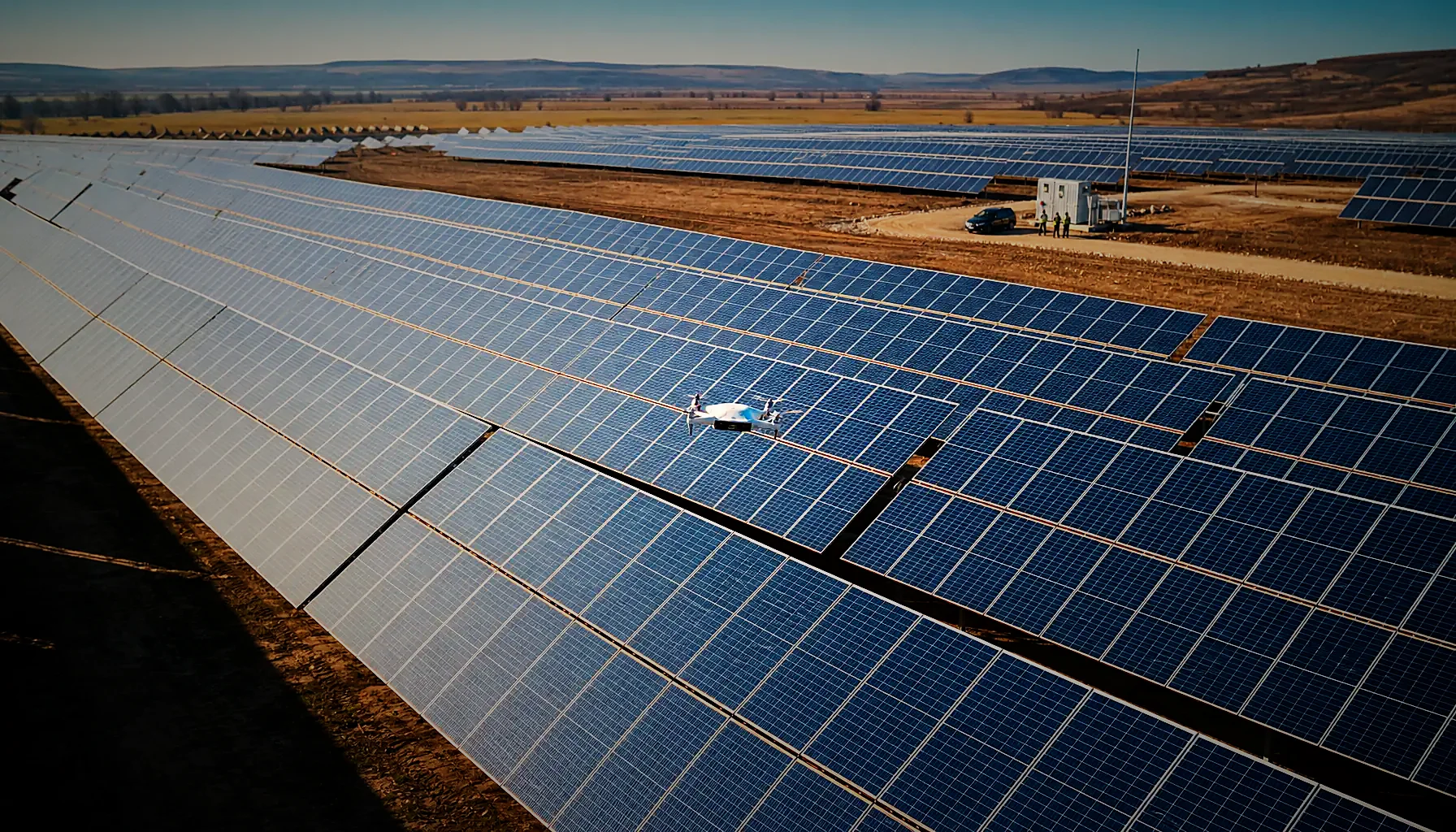
The weather conditions needed for drone thermography of solar panels are irradiance of at least 600 W/m² as recommended by IEC TS 62446-3, a clear or near-clear sky, wind below the airframe limit of roughly 10-12 m/s, no rain or surface moisture, and a stable air temperature. Without these, thermal contrast is too weak to classify faults.
Why does weather decide whether a thermal scan is usable?
A thermal camera does not see defects. It sees surface temperature differences, and those differences only appear when the modules are producing power under strong, steady sunlight. Weather controls how much power the modules produce, so weather controls whether a fault is visible at all.
A hot cell, a bypassed substring or a failed diode becomes measurable because current is flowing and heat is building up at the fault. Under weak irradiance the same fault may show a delta of 1-2 K, which is inside the noise of the measurement and cannot be classified reliably.
This is why a thermal flight is not simply a matter of sending a drone up. The pilot has to choose a window in which irradiance, cloud, wind and ambient temperature are all inside the band the standard describes, and verify those conditions on site rather than trusting a forecast made 48 hours earlier.
In practice the usable window on a clear day in Romania runs from mid-morning to mid-afternoon. Outside that window the sun angle drops, irradiance falls below the threshold, and the dataset becomes a set of pictures rather than a set of measurements.
We record the conditions during the flight — irradiance readings, ambient temperature, wind, cloud state — and include them with the report, so the analysis can be audited later. If an anomaly is challenged a year from now, the conditions under which it was captured are part of the file.
What irradiance is required for a thermal inspection of PV modules?
The minimum irradiance for thermography, following IEC TS 62446-3, is 600 W/m² measured in the plane of the modules. Above 700 W/m² the thermal contrast is stronger and classification of hot cells and bypassed substrings becomes more confident. Below 600 W/m² the flight should not proceed.
Irradiance is measured in the plane of the array, not horizontally. On a fixed-tilt park the tilted plane receives more energy than a horizontal sensor suggests in the morning and late afternoon, which can extend the usable window slightly. On a tracker park the plane follows the sun and the window is longer still.
Steady irradiance matters as much as the absolute value. A sky that swings between 950 W/m² and 400 W/m² as clouds pass produces modules at very different temperatures within the same flight line, and the resulting mosaic cannot be compared cell to cell.
We check irradiance with a reference cell or pyranometer at the start of the flight and at intervals during it. If the reading drops under the threshold the flight pauses rather than continuing and filling the dataset with frames that will later have to be discarded.
Module temperature is the second half of the picture. Under 600 W/m² and above, modules typically sit 20-35 K above ambient, which gives a healthy baseline against which a 10 K hot spot stands out clearly.
For string-level and inverter-level faults the requirement is a little more forgiving, because a whole offline string shows a large uniform delta. For single hot cells and diode faults, which is where most of the diagnostic value sits, the 600 W/m² floor is not negotiable.
See what a thermal scan delivers
Our solar farm thermal inspection page sets out the irradiance and wind conditions we fly in, what you receive and how fast the report lands. Worth a look before you plan your next scan window.
What are the wind limits for a drone thermal inspection?
The practical wind limit for a drone thermal inspection is around 10-12 m/s sustained, which is the airframe limit of platforms such as the DJI Mavic 3T. Above roughly 8 m/s, gusts begin to cost image sharpness and overlap consistency, so the useful working limit is lower than the airframe limit.
Wind affects a thermal flight in three ways. It destabilises the aircraft and smears the frame, it forces the gimbal to work harder to hold nadir, and it convectively cools the module surface, which flattens the very temperature differences the flight is meant to capture.
Convective cooling is the part that is easy to overlook. A steady 10 m/s breeze across an array can reduce the delta of a mild hot cell to the point where it is no longer separable from the background, so a flight can be legal and still produce an unusable dataset.
Gust spread matters more than the average. A forecast of 5 m/s with gusts to 14 m/s is a worse flying day than a steady 8 m/s, because the aircraft spends the flight correcting rather than holding a line, and overlap drifts out of specification.
We measure wind at hub height before the first take-off and again if conditions change. On larger parks, where a mission can run several hours, conditions in the afternoon are often different from the morning, and the flight plan is adjusted rather than pushed through.
Terrain adds local effects. Parks on ridges, near tree lines or beside large industrial halls produce turbulence that no regional forecast predicts, so the on-site reading is the one that decides.
What is the best time of day for a solar thermal scan?
The best time of day for a solar thermal scan is between roughly 10:00 and 15:00 local solar time, when irradiance is above 600 W/m² and the sun is high enough to avoid reflections and long shadows. In Romania this window is widest from late spring to early autumn and narrow in midwinter.
Early morning flights look appealing because the air is calm, but the sun angle is low. Low angles create specular reflections off the glass that register as false hot areas, and they cast row-to-row shadows that corrupt the thermal reading of the shaded modules.
Late afternoon brings the opposite problem. Irradiance drops, modules begin to cool, and the thermal signature of a mild fault fades before the flight is finished, so the first and last flight lines are no longer comparable.
Sun azimuth also governs flight direction. We plan lines so the camera is not looking into the sun’s reflection path, which on a fixed-tilt south-facing array usually means flying east-west legs rather than north-south ones.
Mission size has to fit the window. A roughly 10 MW solar park takes about 2 h 15 min of flying on site, which fits comfortably inside a single good window, while larger parks need the window used efficiently with no wasted repositioning.
On a day of good irradiance the realistic flight capacity is up to about 50 MW, and our largest mission in 2026 covered about 60 MWp over about 70 ha in one or two flight days. Those figures only hold when the weather window is used properly from the first take-off.
For a detailed breakdown of how the window, flight lines and processing fit together on a mid-sized plant, see our guide on how long a thermal inspection of a 10 MW solar park takes.
How does cloud cover affect a thermal inspection of PV modules?
Cloud cover affects a thermal inspection of PV modules by changing irradiance faster than the modules can thermally respond. Clear sky or thin, stable high cloud is acceptable as long as irradiance stays above 600 W/m². Broken cumulus is the worst condition, even when average irradiance looks adequate.
Modules have thermal inertia of a few minutes. When a cloud shadow passes, output drops immediately but surface temperature falls gradually, so frames captured in the minutes after a shadow show modules that are cooling at different rates across the array.
The result is a mosaic with temperature banding that has nothing to do with faults. An analyst then has to decide whether a warm region is a real cluster of underperforming modules or simply a patch that saw sun 90 seconds longer than its neighbour.
Thin, uniform high cloud is different. If it holds irradiance steadily above the threshold and does not break, it can even help by reducing specular glare, though it narrows the margin and should be monitored continuously.
Overcast conditions rule out thermography entirely. Diffuse light under heavy cloud rarely reaches 600 W/m², module temperature sits close to ambient, and the only faults still visible are complete string outages that a monitoring platform would already have flagged.
Rain, dew and surface moisture are an automatic stop. Evaporative cooling is uneven across a module, soiling patterns hold water differently, and the drying surface produces thermal patterns that mimic defects. We wait until the array is dry, which on a clear morning usually means an hour or two after sunrise.
Snow cover is the same case taken further: no production, no thermal signal and a reflective surface. Winter inspections in Romania are possible on clear high-pressure days, but the usable window may be only two or three hours.
Planning a scan for your PV park?
We fly a roughly 10 MW park in about 2 h 15 min and record the conditions alongside every anomaly. Read how we run thermal inspections on solar farms in Romania.
How do you plan a mission around the weather window in Romania?
Planning a thermal mission in Romania means booking a weather window rather than a date. We watch irradiance and wind forecasts for the site, confirm the flight day 24-48 hours out, mobilise anywhere in Romania in 24 to 72 hours, and verify conditions on site before the first take-off.
Romania’s continental climate gives reliable high-pressure days from April to September, with clear, low-wind mornings being the most dependable part of the day. Spring and early autumn often produce the best combination: strong irradiance, calm air and moderate ambient temperature.
Midsummer is not automatically ideal. Very high ambient temperature raises module temperature across the whole array, which compresses the relative contrast of mild faults, and afternoon convective storms close the window early.
We build a flight plan to the specification the analysis requires — thermal GSD, flight height, line spacing and overlap — and keep that specification constant regardless of the weather window used. Changing altitude to save time in a shrinking window would change GSD and break comparability with previous campaigns.
Coverage is checked before we leave the site. Frames are reviewed for overlap, focus and irradiance consistency while the aircraft is still on the ground, because a return visit costs far more than 20 minutes of verification.
Reporting follows the flight on a fixed schedule: report turnaround for parks up to 20 MW is 5 working days, and a quote is returned within 24 hours on working days. In 2026 we flew over 400 MW of PV capacity under these conditions, and in 2026 the planning method has not changed — the weather decides the day, the specification decides the flight.
Deliverables are PDF reports with anomalies classified and located, plus the complete dataset with EXIF and GPS intact, in the folder structure or platform uploader requested. Flights are carried out by EASA A1/A3 and A2 certified pilots.
Frequently asked questions
What temperature is too cold to fly a drone?
Most consumer and enterprise drones, including the DJI Mavic 3T, are rated to operate down to about -10°C, below which battery capacity and flight time drop sharply. For PV thermography the limiting factor is usually not the aircraft but the irradiance and the module temperature, which in cold, low-sun conditions rarely give enough thermal contrast. On a clear winter high-pressure day in Romania a scan is possible, but the usable window may be only two to three hours around solar noon.
At what temperature do solar panels become inefficient?
Crystalline silicon modules lose roughly 0.3-0.45% of their output per degree above the 25°C standard test condition, so efficiency falls steadily as the cell heats up. On a hot summer day module temperature can reach 60-70°C, which costs a meaningful share of output even with no faults present. For thermography this matters because very high ambient temperature compresses the relative contrast between healthy and faulty cells, making mild anomalies harder to classify.
How much does drone thermography cost?
The cost of a drone thermal inspection depends on plant capacity, site layout, access, the analysis platform used and the deliverables required, so it is quoted per project rather than from a list. The variables that move the figure most are total MW, the number of separate sites and whether the output is a PDF report, a platform upload or a full raw dataset. Request a personalised quote and you will have it within 24 hours on working days.
Can a drone inspect solar panels?
Yes. A drone carrying a radiometric thermal camera and an RGB camera can inspect an entire solar park from the air, locating hot cells, bypassed substrings, offline strings, diode faults and soiling without taking modules offline. A roughly 10 MW park takes about 2 h 15 min of flying on site, and on a day of good irradiance the realistic capacity is up to about 50 MW.
What irradiance is required for a thermal inspection of PV modules?
A minimum of 600 W/m² in the plane of the modules, following the recommendations of IEC TS 62446-3. Readings above 700 W/m² give stronger thermal contrast and more confident classification of single-cell and substring faults. Irradiance should also be stable, because a sky swinging between 950 and 400 W/m² produces frames that cannot be compared with each other.
How often should a solar park be inspected with a thermal drone?
Once a year is the common baseline for an operating park, usually scheduled in the same season each year so results stay comparable. Many owners add a second scan after commissioning, after a hail or storm event, or before the end of a warranty period. Parks with known degradation issues or performance disputes are often flown twice a year.
Related services
Solar farm thermal inspection
Radiometric thermal and RGB survey of PV plants, with every anomaly classified and located by string and module. Report in 5 working days for plants up to 20 MW.
See the service
Thermal and visual drone inspections
Roofs, facades, industrial halls, power lines and wind turbines inspected from the air, with an annotated report and a ranked defect list.
See the service
Tell us about your site
Send the location, the size and the deliverable you need. We reply with a written quote and a proposed flight window.
- Reply within 24 h on working days
- Written quote, no obligation
- Your data stays confidential
We work across Romania, with mobilization in 24–72 h.